
From Sketch to 3D Figurine: How Does a Child Create a Character?
An original 3D figurine does not appear from nowhere. ET Art Studio explains how children move from sketch and character design to modeling, printing, and finishing.
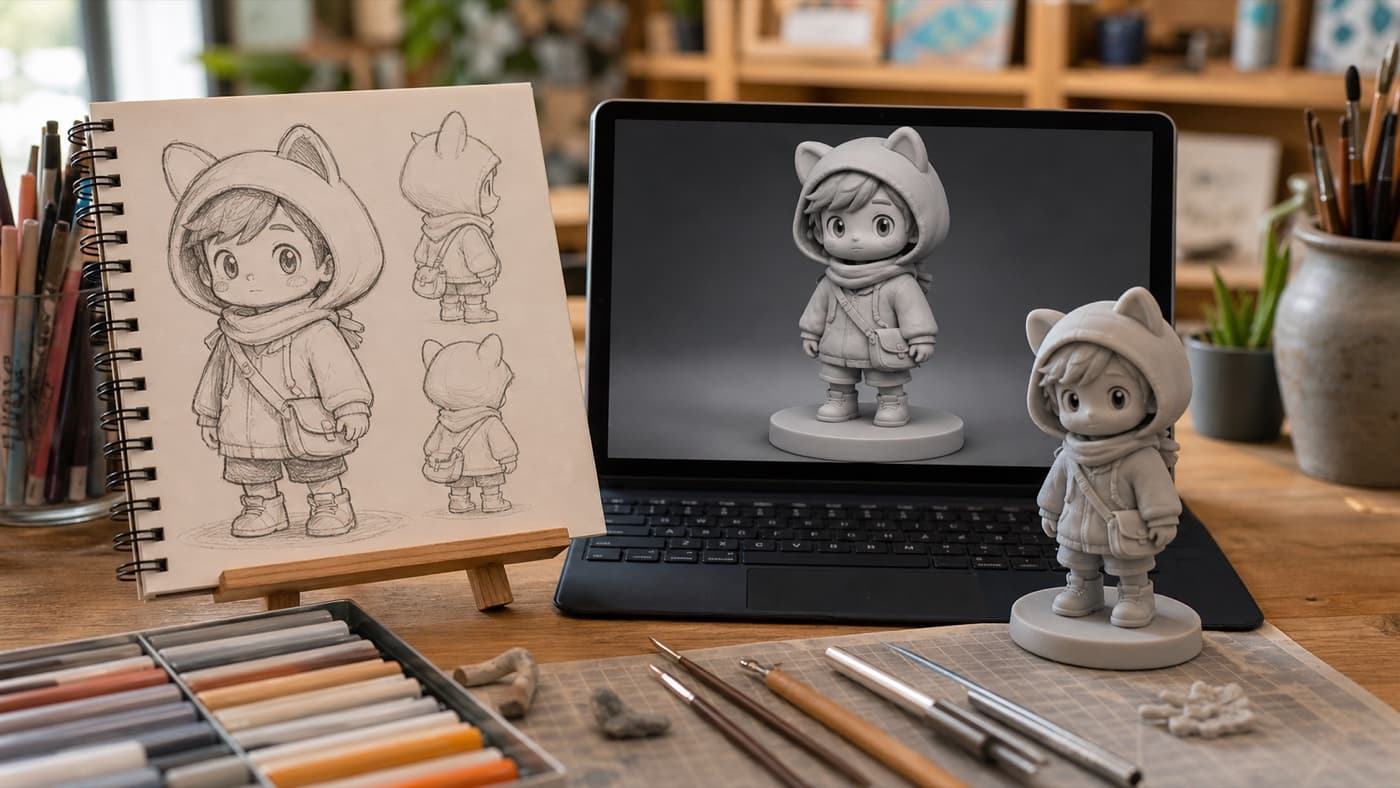
Many children love figurines. They enjoy looking at them, collecting them, and inventing stories for characters.
But if one day a child can make a figurine that belongs completely to them, the sense of achievement is very different.
Because it is no longer only I like this character. It becomes I created this character.
Step one: a character does not begin with software, but with story
A good 3D figurine usually begins with an interesting character concept.
Who is this character? Where do they come from? Are they timid or brave? Do they have a signature prop? Are they a small wizard, a space mechanic, a forest guardian, or a robot that can bake cakes?
Children first imagine the story, then draw sketches. This gives the character more life.
If they open software and immediately start stacking shapes, the work may easily become just a model. But if the character comes first, children naturally begin to think: What should the eyes feel like? What pose should the character have? Is there anything special about the clothing?
Step two: turn a flat sketch into a three-dimensional idea
A sketch on paper is flat, but a figurine needs to work from every angle.
So children begin to think: What does the front look like? Is the side thick enough? Are there details on the back? Do the head and body proportions fit? Can the character stand steadily?
This step is key. It moves children from drawing a character to designing a character.
At ET Art Studio, we guide children to observe the main features of a character. Is the most important part big ears, a cape, a hat, or a small prop in the hand? The clearer the focus, the easier the figurine is to remember.
Step three: 3D modeling helps the character stand up
During the modeling stage, children break the character down into basic forms.
The head may begin as a sphere. The body may begin as a cylinder or cube. Ears, horns, wings, shoes, and bags can all be combined, stretched, and adjusted from different shapes.
Children discover that a complex work is not made all at once. It is slowly built from many simple parts.
This process trains patience and also trains the ability to break down problems.
Step four: prepare for 3D printing
Not every model that looks good on screen is suitable for printing.
If the hair is too thin, it may break. If an arm floats too far out, it may need support. If the base is too small, the work may not stand. If the details are too dense, they may not show clearly after printing.
So in a 3D figurine course, children also need to learn production awareness: the work will eventually move from the virtual world into the real world.
This helps children understand materials, structure, and craft. Art is not only imagination. It also needs to land in reality.
Step five: print, refine, and paint
When the model is finally printed, children are very excited. But the work is not truly finished yet.
Some parts need cleaning. Some edges need attention. Some characters can be painted, and some can have a base or small scene added.
This stage connects 3D modeling with traditional art. Children face color, texture, detail, and overall effect again.
A white model becomes a character with personality after painting. This is one of the most charming parts of figurine creation.
What kind of child is a 3D figurine class suitable for?
Children who like anime, game characters, monsters, toys, and story creation usually enjoy 3D figurines.
It is especially suitable for children with rich imagination who need to learn how to organize ideas. Figurine creation asks children to connect story, drawing, modeling, structure, and color.
It is not one isolated skill. It is a complete project.
From I like it to I created it
When children like a character, that is the beginning of aesthetic awareness. When children can create a character, that is the beginning of expression.
At ET Art Studio, we hope children do not only copy existing images, but gradually develop original ability. From sketching to modeling, from printing to painting, every step helps children see more clearly: my idea can be completed seriously.
If your child loves anime figurines, character design, or 3D creation, you are welcome to learn about ET Art Studio's 3D figurine courses. Perhaps the next character with a story will come from your child's own imagination.