
When Art Class Meets Technology Class: Why Future Children Need Cross-Disciplinary Creation
Art and technology are not separate paths. ET Art Studio explains how drawing, 3D modeling, 3D printing, and creativity connect with future abilities.
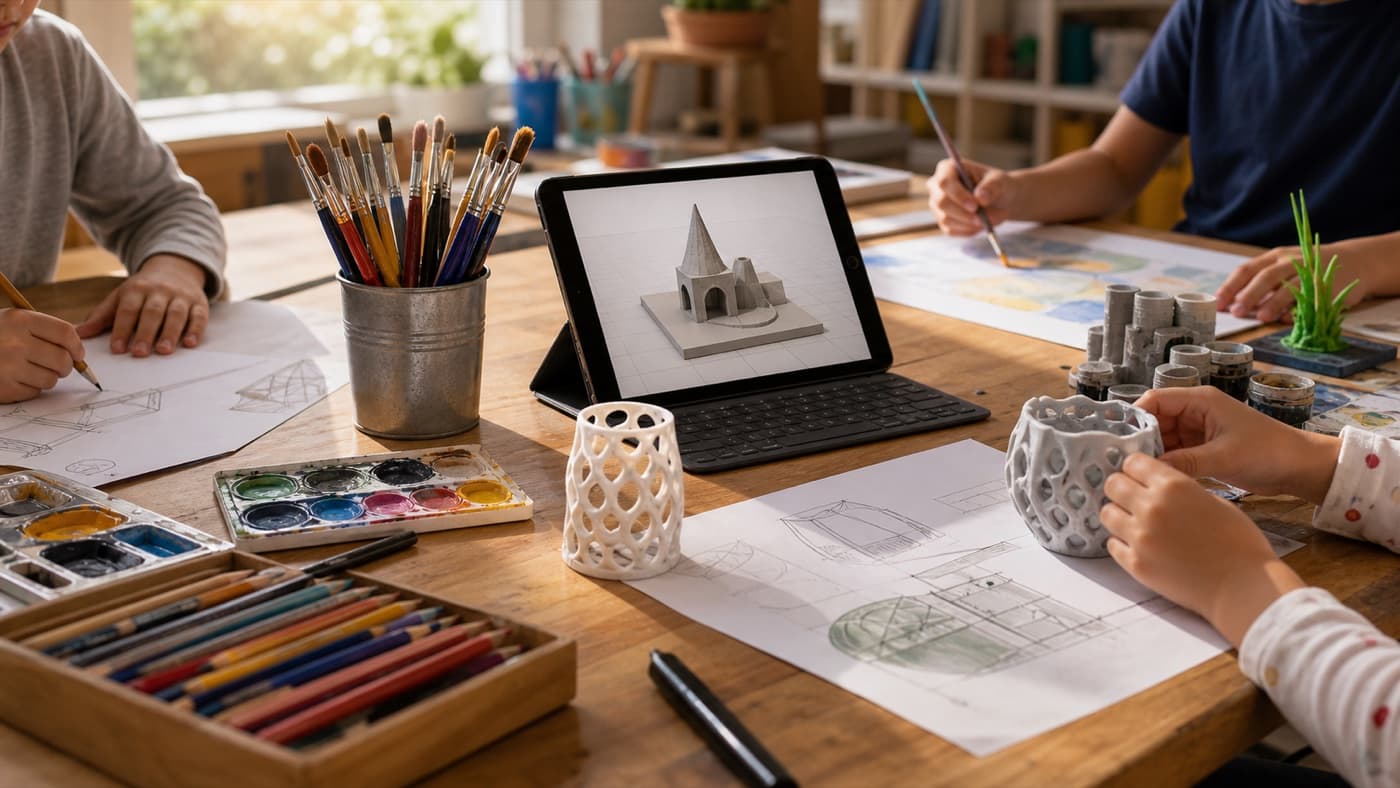
We used to divide courses very clearly: drawing is art, coding is technology, handcraft is handcraft, and models are models.
But children's real creative process is not divided that way.
If a child wants to design a future city, they may need to draw sketches, make structures, consider transportation, build models, choose colors, and even use 3D printing to create buildings. There is art and technology, imagination and logic.
Future creativity increasingly looks like a cross-disciplinary ability.
Art gives technology imagination
Technology tools are powerful, but tools do not automatically produce good ideas.
A 3D printer can print many things, but what should it print? Why design it this way? Does it look good? Does it have emotion? Does it have a story? These questions require artistic thinking.
Art helps children dare to imagine, and it also teaches them how to make a work more engaging.
A robot does not only need to stand. It can have expression, personality, and a color style. A building does not only need a stable structure. It can have a theme, light and shadow, and a sense of space.
Technology gives art new exits
Art no longer needs to stay only on paper.
Children can draw a character first and then use 3D modeling to make it three-dimensional. They can design a small badge and print it into a real object. They can draw a future vehicle and turn it into a model. They can make a story prop real.
Technology tools help children understand that creativity can move from I imagine it to I made it.
This transformation is very important. It gives children more confidence in their ideas and makes learning more concrete.
Cross-disciplinary creation trains combined abilities
In a good technology art class, children use many abilities at the same time:
- Aesthetic judgment: how to make something look better and have style.
- Spatial thinking: how an object works in three dimensions.
- Logical planning: what to do first and what to do next.
- Hands-on ability: how to make the work more stable and detailed.
- Problem solving: how to revise after failure.
- Expression: how to clearly explain a design.
These abilities are not learned by memorizing facts. They are practiced through a complete project.
Why do children need project-based learning?
When children make a complete work, they naturally encounter real problems.
For example, they design a small animal that can fly. It looks beautiful in the drawing, but during modeling the wings are too thin. During printing the body is too heavy. During painting too many colors make it messy. So the child must keep judging, choosing, and adjusting.
This is more valuable than simply completing one step.
Because many future problems are not single-subject questions either. They require children to integrate information, try solutions, correct mistakes, and express results.
Why does ET Art Studio combine art and technology?
ET Art Studio's core is still creativity education.
Drawing, color, sketching, anime, 3D modeling, and 3D printing may seem like different courses, but they all help children complete one thing: express their own ideas.
The difference is only the medium of expression.
Sometimes it is a drawing. Sometimes it is a model. Sometimes it is a character figurine. Sometimes it is a future scene. The richer the tools children encounter, the more ways they have to express the world.
What kind of child is suited to technology art classes?
Children who like drawing but want to make real objects are suited.
Children who like building blocks, models, machines, and spatial structures are suited.
Children who like anime characters, game props, and figurines are also suited.
Children who have many ideas but do not know how to complete them are especially suited.
Technology art class does not require children to be advanced from the beginning. It gives them a path from interest to completed work.
The future needs people who can connect
Future children do not all need to become artists, engineers, or designers. But they all need one ability: to see a problem, propose an idea, choose tools, and complete an expression.
Art gives children feeling. Technology gives children methods. When the two work together, creativity can land more easily.
If you hope your child can not only learn to draw a picture, but also turn imagination into models, figurines, and real works, you are welcome to learn about ET Art Studio's technology art courses. We connect drawing, 3D modeling, and 3D printing in child-friendly ways so creation can truly happen.