
Why It May Be a Good Thing When a Child's Drawing Does Not Look Realistic
When a child's drawing does not look realistic, it is not always a problem. ET Art Studio looks at children's art foundations, observation, imagination, and creativity through the way children draw.
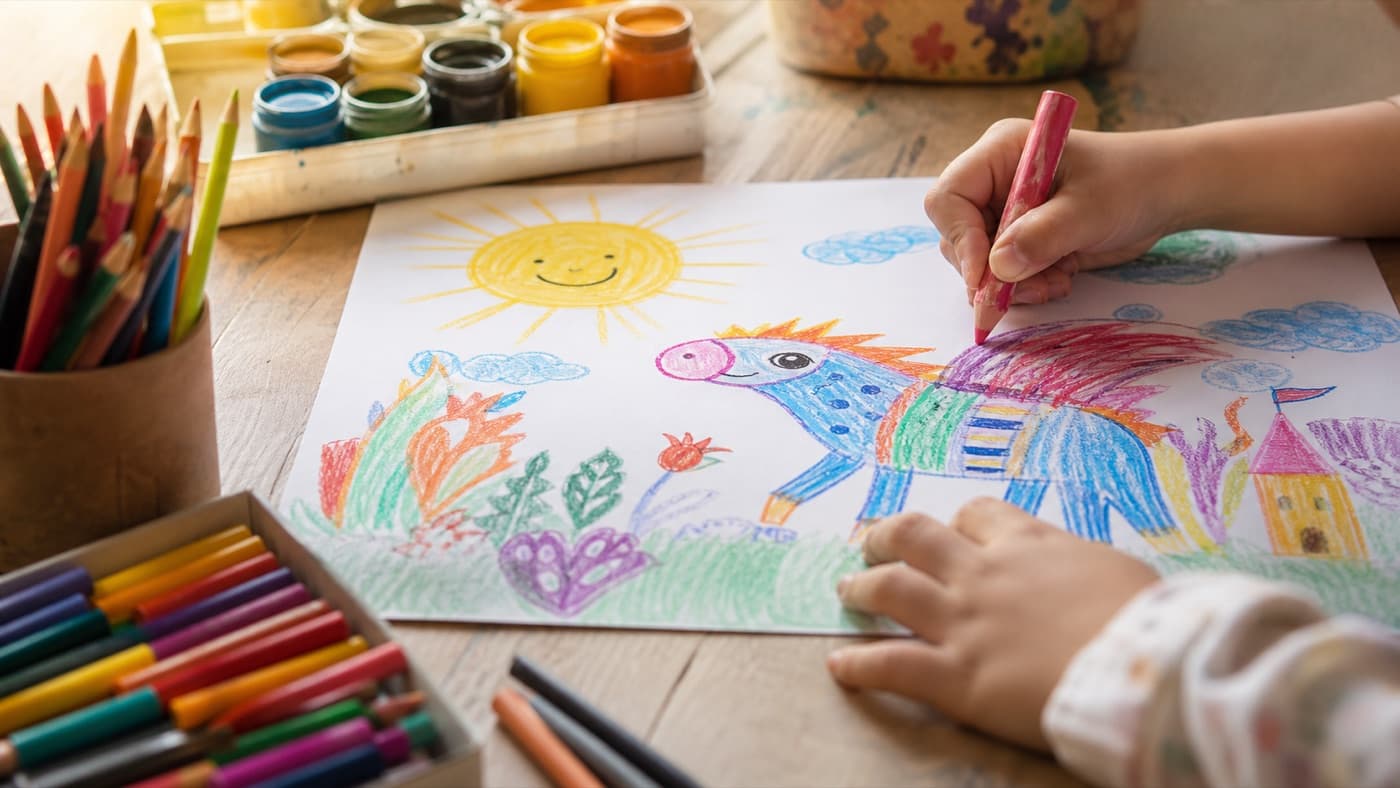
Many parents, when they first look at a child's drawing, cannot help asking: Is this a person? Why are the eyes on top of the head?
The child nods very seriously: Yes, he is looking at the dinosaurs in the sky.
At moments like this, adults often hesitate a little. Should we correct it? Should we tell the child, The eyes should go here? If a child draws something that does not look realistic, does it mean they have no talent for art?
At ET Art Studio, we often remind parents that when a child's drawing does not look realistic, it is sometimes not a mistake. It may be the child using their own way to understand the world.
A child's drawing is first an idea, not a photograph
Adults often look at a drawing and first ask whether it looks accurate.
Children often look at a drawing and first ask whether it is interesting.
A four- or five-year-old child may draw a house with an enormous door because what they most look forward to is pushing the door open and going inside. They may draw their mother with very long arms because Mum is always hugging them. They may add a smile to the sun because, in their world, the sun is not a celestial body but a friend who goes out with them.
These images may not follow perspective, proportion, or structure, but they hold something very precious: the child's experience, emotions, memory, and imagination.
The most important part of early art education is not to train children immediately into little adults. It is to protect their willingness to express.
Behind the unrealistic drawing, observation may be happening
One child once drew a cat in class. The cat's whiskers became more than a dozen long lines, almost filling half the page. The teacher asked: Why are the cat's whiskers so long?
He said: Because when a cat walks, its whiskers know where the path is first.
This was not random drawing. It was the child's understanding after observation.
The child may not yet be able to draw a cat's bones, fur, and proportions accurately, but he noticed the function of the whiskers and enlarged that discovery. For children, drawing is not simply copying an appearance. It is telling others what they think is important.
This is something we value deeply in ET Art Studio's creative art classes. We do not rush to turn every child's work into the same standard answer. We first guide them to see, ask questions, choose, and then gradually learn ways to express what they notice.
When should technique be taught?
Of course, protecting imagination does not mean never teaching methods.
At different ages, children naturally encounter new challenges in expression:
I want to draw a dog running, but I cannot draw it.
I want to draw a deep forest, but it looks flat.
I want my character to look better, but something feels awkward.
At that point, technique becomes a tool.
Line, shape, color, composition, light and shadow, proportion, and perspective are not there to restrict children. They help children bring the images in their minds onto the page more clearly.
Good children's art teaching should feel like offering a toolbox. When a child needs something, the teacher helps open that part of the box, instead of pressing every rule onto the child from the start.
How can parents respond to a child's drawing?
When a child brings you a drawing that does not look very realistic, try asking less, What did you draw? and try questions like:
- Which part of this drawing do you like the most?
- What story is happening here?
- Why did you choose this color?
- If you added another character, who would it be?
- What did you most want me to notice when you were drawing?
These questions help children feel that adults are not there to grade them, but to truly enter their world.
When a child is willing to speak, willing to draw, and willing to keep trying, art learning has truly begun.
At ET Art Studio, we want more than realistic drawing
At ET Art Studio, we do teach children observation, form, color, and technique. More importantly, we hope children can keep one ability while drawing: the courage to imagine, to try, and to express.
Drawing realistically is one ability.
Drawing with a sense of self is another, longer-lasting ability.
If your child is drawing things that seem strange or unusual, perhaps pause before correcting them. That may be imagination knocking at the door.
Follow ET Art Studio for more content on children's art, creative drawing, and early art education. You are also welcome to book a trial class and let your child walk into the studio with their own story.