
3D Modeling Is Not Just Playing on a Computer: Children Build Spatial Thinking in Modeling Class
3D modeling is not only using software. ET Art Studio explains how children's modeling classes train spatial sense, logic, and design expression.
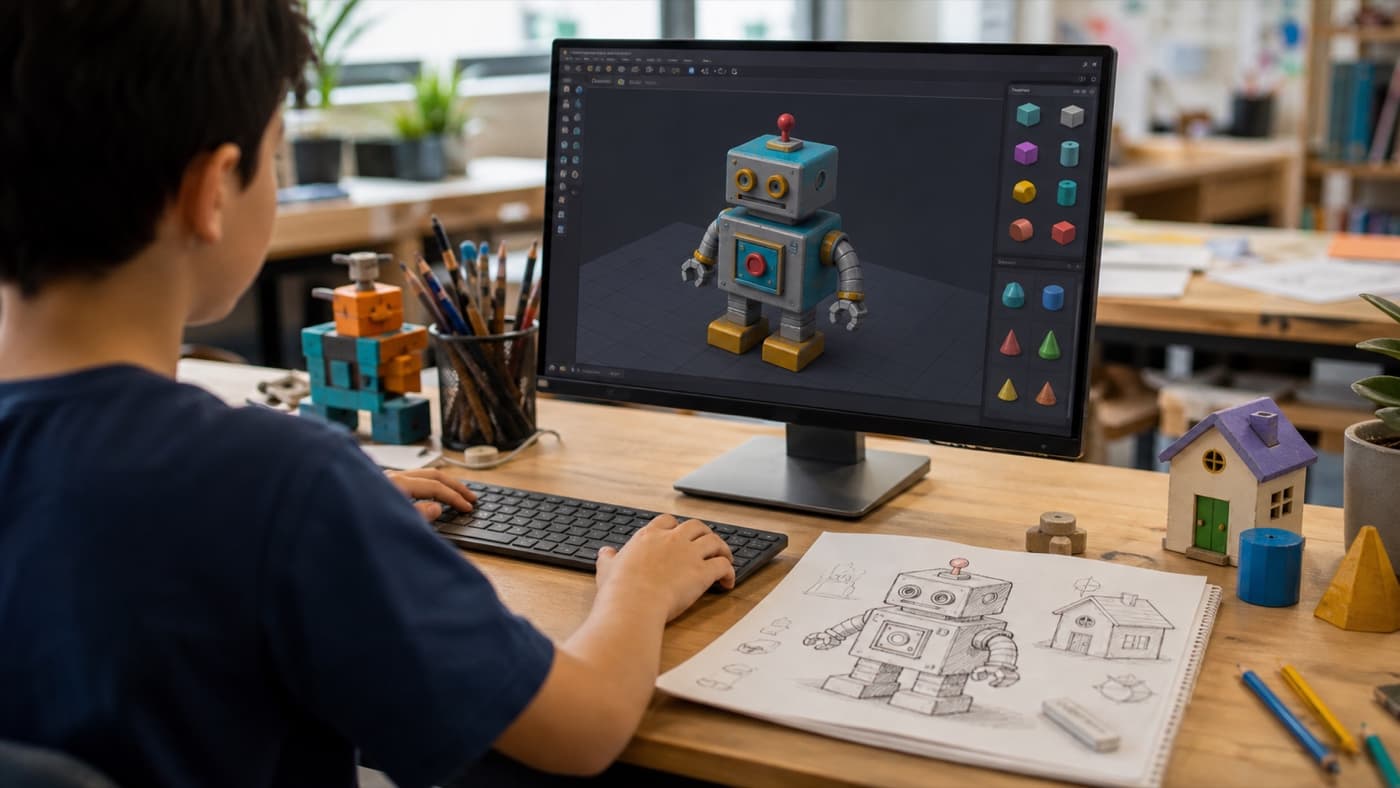
When parents hear 3D modeling, some feel nervous: Will my child just be staring at a computer again? What does this have to do with art?
In fact, a good 3D modeling class is not about making children addicted to screens. It helps children learn to observe and create in a new way.
It is like building with blocks inside a computer, but freer than blocks. It is like drawing, but not limited to paper. It is also like design, because every shape needs to consider proportion, structure, and purpose.
From seeing the front to seeing all the way around
When children draw, they often get used to looking at an object from one angle. A car may be drawn from the side. A house may be drawn from the front.
3D modeling suddenly helps children realize that a work can be rotated.
If the front looks good, the side must also make sense. If there is a roof on top, there must also be a base underneath. If a character's face is designed, the back of the head and hair must connect too.
This trains spatial imagination. Children need to turn an object around in their minds and understand that it is not a flat picture but a three-dimensional existence.
The logic inside modeling class
3D modeling is not randomly stacking shapes.
Children need to think clearly: Which part should be made first? Which shapes can be combined? What needs to align? Which proportion is too large or too small? If it will be printed, which part needs to be thickened?
These are all logical questions.
For example, when making a small robot, a child may start with the body, then add the head, arms, legs, and eyes. But during the process, they may discover that the arms are too long, the feet are too small, or the head is too heavy, making the whole piece unstable. Then they must adjust it.
This process is like practicing design reasoning: one choice affects another choice.
3D modeling and art foundations support each other
Children who have studied drawing often have an advantage in 3D modeling because they are more sensitive to shape, proportion, silhouette, and character features.
Children who have studied 3D modeling also understand structure better when they return to drawing. They know a cup is not only an oval line, a head is not only a face, and a house is not only a triangle plus a square.
So 3D modeling is not a replacement for traditional art. It is an extension and complement.
At ET Art Studio, we hope children can both draw ideas and make ideas. When flat expression and three-dimensional expression work together, children's creativity becomes more complete.
Are children too young to learn the software?
Children's 3D modeling classes should not begin by chasing complex software operations.
Younger children can start with simple forms: spheres, cubes, cylinders, letters, animals, buildings, and toy parts. The focus is understanding how shapes combine, not memorizing many buttons.
As age and ability grow, children can gradually learn symmetry, rotation, combining, hollowing, proportion adjustment, simple materials, and printing preparation.
The best way for children to learn software is not by memorizing a menu, but by using tools while making something they want to make. They know why they are clicking a button and how the work will change afterward.
How can parents judge whether a modeling class is good?
You can look at three things:
First, does the child have their own design idea instead of only following a template?
Second, does the teacher guide the child to understand structure, not only steps?
Third, after completing the work, does the child review what succeeded and what can still improve?
If a child only completes an identical model, the learning may be shallow. A truly good modeling class helps children accumulate judgment through each work.
Modeling builds the world inside the mind
Children do not learn 3D modeling only to use one software program.
They learn the ability to start from a vague idea and gradually turn it into a clear structure. This ability can be used in art, design, architecture, games, animation, engineering, and many future careers.
At ET Art Studio, 3D modeling connects children's imagination, aesthetics, and technology tools. We hope children are not only able to look at others' works, but also able to create their own three-dimensional worlds.
Contact ET Art Studio to learn about children's 3D modeling courses suited to different ages and stages.