
Why Children Become Fascinated by 3D Printing: Imagination Can Finally Be Held
3D printing is not just a machine producing a model. ET Art Studio explains how children turn imagination, design, and hands-on thinking into real works.
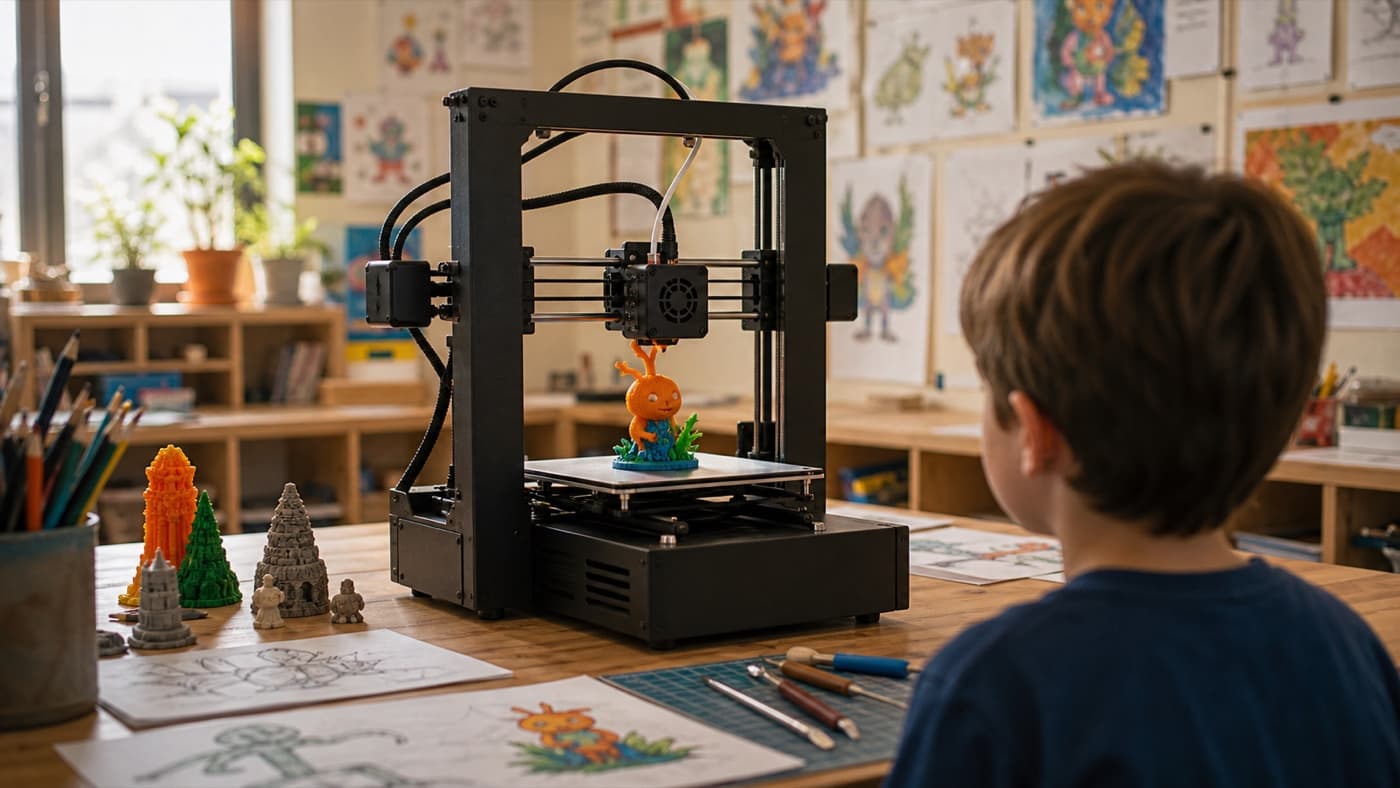
Many children stare for a long time the first time they see a 3D printer working.
A thin strand of material comes out of the nozzle and builds layer by layer. At first it is only an unclear base. After a while it looks like a small hill. Then ears, wings, or castle towers appear, and finally it becomes a work that can be held in the hand.
That feeling is special: the thing in my mind can become real.
3D printing is not just pressing a button
Some parents think a 3D printing class means children choose a model and the machine prints it automatically. That can be fun, but it is not the complete learning experience.
A truly valuable children's 3D printing course focuses not only on printing, but on letting children go through a full creative process: choose a theme, draw sketches, think about structure, make a model, adjust proportions, print it, observe problems, and revise again.
In this process, children are not simply watching a machine work. They are learning design.
Children naturally learn spatial thinking
Flat drawing expresses the world on paper. 3D printing asks children to think in length, width, and height.
If a little monster's horn is too thin, will it break? If a cup handle is too narrow, can it be held? If a castle base is too small, will it fall over? If a character's feet are too small, can it stand?
These questions help children realize that a work is not enough if it only looks nice. It also needs to make sense in the real world.
This is the beginning of spatial thinking and engineering thinking.
Children learn more from failure than from the finished object
3D printing is very honest. If a model is designed poorly, the machine will not pretend not to notice.
Sometimes the work falls over, details become blurry, supports are not handled well, or the scale is too small for details to show. Children may feel disappointed, but this is an excellent learning opportunity.
The teacher can look with the child: Which part is too thin? Which part is floating? What needs to be thickened? Which part can be split into pieces and assembled later?
Children gradually understand that failure does not mean I cannot do it. It means the work is telling me what to change next.
What does 3D printing have to do with art?
A great deal.
A good 3D work is not only technically correct. It also needs aesthetics. Are the shapes interesting? Are the proportions harmonious? Does the surface have rhythm? How should the colors work together? Does the character have personality? These all come from art training.
At ET Art Studio, we prefer to see 3D printing as technology art. It needs both logic and imagination, both software and equipment, and also form, color, and story.
What children learn here is not simply operating a machine. It is the ability to turn ideas into works.
What kind of child is suited to 3D printing?
Children who like building blocks, crafts, monsters, designing houses, or studying toy structures often enjoy 3D printing.
It is also suitable for children who often say, I want to make something of my own.
Younger children can begin with simple forms, name tags, small animals, and small buildings. Older children can try characters, props, mechanical structures, scene models, and figurine design.
Imagination is happiest when it can be seen and held
When children receive something they designed and printed themselves, they often touch it again and again, look at it carefully, and explain: This is the door I designed. A little person can go here. This horn was too thin at first, so I made it thicker.
This is the sense of achievement that creation brings.
3D printing teaches children that imagination is not something floating in the air. It can be designed, revised, and made.
If you would like your child to experience a children's 3D printing class that combines art and technology, learn more about ET Art Studio's technology art courses. Let your child begin with a sketch and slowly turn their idea into a real work.