
What Can One Pencil Teach a Child? Focus and Observation in Sketching Class
Sketching is not only black, white, gray, or drawing realistically. ET Art Studio explores how children build observation, patience, and focus through one pencil.
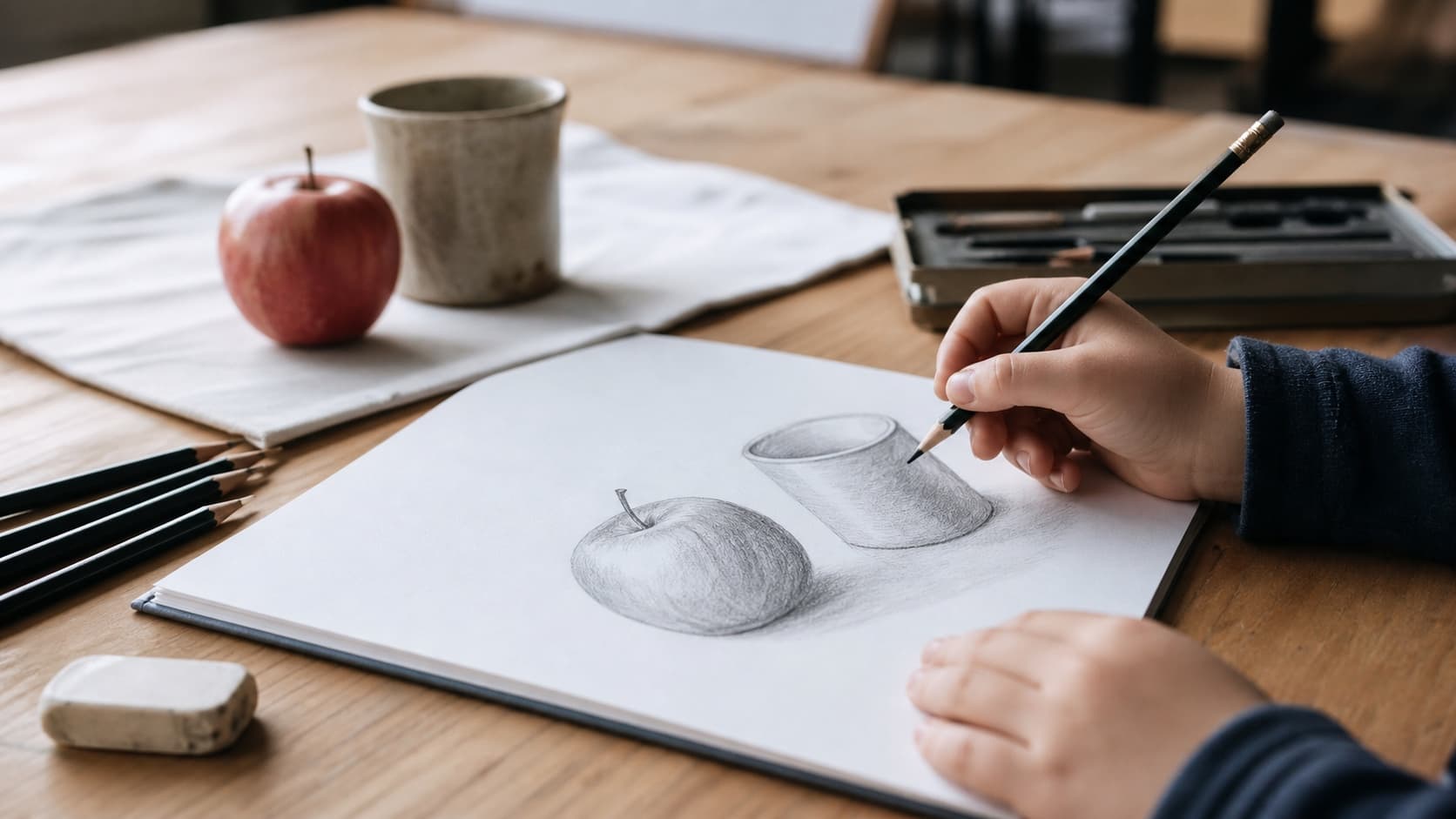
In many people's minds, sketching feels a little serious: black, white, gray, plaster casts, hatching, light and shadow. It can seem far away from a child's free imagination.
But in ET Art Studio's classroom, one pencil often helps children become quiet.
Not because they are told to be quiet, but because they begin to truly see something.
The first sketching lesson is not line, but observation
When an apple is placed on a table, an adult may say: Isn't this just an apple?
But a sketching class invites children to look slowly:
Is the apple perfectly round?
What color is the side facing the light?
Is the shadow side only black?
Why is there a darker ring where the apple touches the table?
When a child first discovers that a white cup also contains gray, that a shadow is not just one black patch, and that a circle has many directions of line, they are practicing a very important ability: careful observation.
This kind of observation does not only serve drawing. It can also influence reading, writing, science experiments, and even everyday judgment.
The rhythm inside a pencil
Sketching is well suited to training focus because it has a natural rhythm.
Lighter, and the line feels like breathing.
Heavier, and the form begins to stand up.
Slower, and the structure becomes steadier.
Rushed, and the picture becomes messy.
When children practice hatching, they gradually realize that the strength of the hand, the judgment of the eye, and the patience of the mind are connected. Many children begin by saying, Teacher, I am done. But when they look again, they notice the shape is not accurate, the shadow has not opened up, and the edges still need attention.
Sketching class is not about making children slow. It is about helping them settle down when a task needs depth.
Mistakes are part of sketching
One valuable thing about sketching is that it allows revision.
If a line is crooked, you can compare.
If the proportion is off, you can adjust.
If a shadow is too heavy, you can lift it.
If the structure is unclear, you can find it again.
Through this process, children learn that a mistake is not failure. It is information. The picture tells you what is not working, and then you try again.
This psychological experience is very precious. It teaches children that ability is not proven by one success. It grows through repeated observation, judgment, and adjustment.
Should children's sketching class be boring?
No.
Children's sketching can begin with many interesting objects: toy cars, shells, sneakers, building blocks, plants, snack packaging, or a child's own water bottle. Familiar objects reduce distance and make children more willing to look and draw.
At ET Art Studio, we arrange content according to age and foundation. Younger children can begin with lines, shapes, and light-and-dark games. Older children can gradually move into structure, perspective, still life groups, and basic figure drawing.
A truly effective sketching class does not ask children to mechanically spend time. It helps them understand why they draw this way, what they see, and how they can improve.
How can parents tell whether a child is ready for sketching?
If your child shows these signs, it may be a good time to explore sketching foundations:
- They begin to care whether their drawing looks realistic.
- They want to draw more complex objects or people.
- They are interested in light, volume, and space.
- They are willing to spend more time revising a drawing.
- They are preparing to study anime, illustration, design, or exam-based art more deeply.
Sketching is not the opposite of creativity. It is like a framework that gives imagination a place to stand.
One pencil can open a world
Beyond colorful paints, the pencil gives children another kind of quiet strength. It is not flashy, but it is honest. The more carefully you look, the more it gives back.
ET Art Studio's sketching courses hope children learn not only light, shadow, and proportion, but also the patience to observe, the courage to revise, and the ability to go deeper into one thing.
If you are looking for children's sketching classes or foundational drawing courses, contact ET Art Studio to learn about a learning path that fits your child's age and stage.