
A Small Studio Story: How a Quiet Child Used Drawing to Speak
Some children do not speak much, but they say a lot through their drawings. ET Art Studio shares how art can help children express emotion and build confidence.
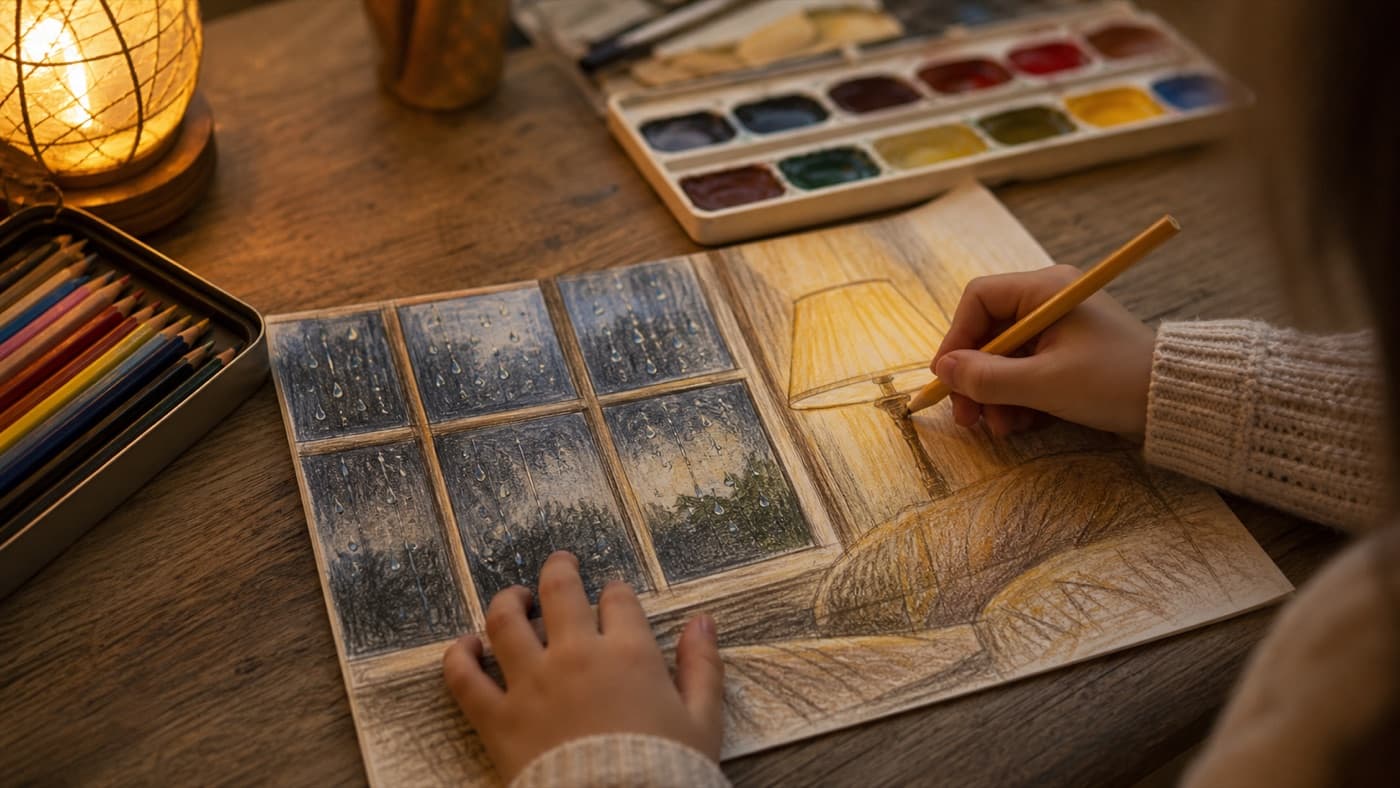
In the studio, there is a kind of child who does not rush to answer questions and does not actively show their work. When the teacher comes near, they gently push the paper forward, while their eyes still look at the table.
This kind of child does not necessarily lack ideas. Many times, they simply have not found a comfortable way to express them.
Drawing often becomes their first language.
The picture that was always raining
There was once a child who spoke very little when he first came to ET Art Studio. During class discussions, he usually only nodded. When the teacher asked what he wanted to draw, he would quietly say: Anything is fine.
For several classes in a row, rain appeared in his drawings.
The first was a small house in the rain.
The second was a little person holding an umbrella.
The third was rain outside the window and a lamp inside the room.
The pictures were not loud or bright, but they were delicate. Raindrops fell in rows, and the yellow light in the window was small but very intentional.
The teacher did not rush to ask, Why do you always draw rain? Instead, she first asked: What is the person in this room doing?
He said: He is waiting for the rain to stop.
After a moment, he added: But he is not afraid, because the light is still on.
At that moment, the drawing reached the child's inner world before words did.
Sometimes children are not unwilling to express; they do not yet know how to say it
Adults are used to solving problems with language: What happened? Why are you unhappy? What do you want?
But children's feelings sometimes have not yet become clear sentences. A child may only feel heavy, messy, nervous, or unable to explain.
Drawing gives the child another path.
They can draw fear as a huge shadow, happiness as a sky full of stars, longing as a very long road, and safety as a lamp.
These pictures do not always need to be over-interpreted, but they deserve to be seen carefully.
Art class also builds confidence
Later, this child began adding more things to his pictures.
After the rain stopped, there were puddles on the ground. Trees were reflected in the puddles. A small dog appeared beside a tree. Later still, the person in the picture walked out of the house and went farther away with an umbrella.
His colors also gradually increased. He did not suddenly become very outgoing, but he became more willing to try within the picture.
During one sharing session, his voice was still soft, but he completely explained his work: This is the city after rain. When the streetlights turn on, the ground also lights up.
For the teacher, this was an important kind of progress.
Not every child needs to become especially lively. Confidence has many forms. Some confidence speaks loudly. Some confidence quietly but firmly completes a work and is willing to let others see it.
What can teachers do?
At ET Art Studio, we believe good children's art education is not only about teaching children to make beautiful works. It is also about giving children a safe space for expression.
A teacher's job is not to explain everything for the child, but to accompany the child as they slowly open up:
- Look carefully at details in the child's drawing.
- Guide with questions instead of rushing to judge.
- Allow the child to keep some silence.
- Encourage sharing at the right moment.
- Help the child turn vague ideas into a picture they can complete.
When children feel that their expression is respected, they become more willing to continue expressing.
Parents can also look at a child's drawing this way
When a child brings artwork home, parents can pause before saying good, bad, or it does not look right. Instead, ask:
- Where do you most want me to look in this picture?
- What is happening here?
- What were you thinking about when you drew this part?
- If this picture had a sound, what would it sound like?
These questions open children more than simple evaluation.
Sometimes, what a child needs is not a score, but someone willing to listen seriously to their drawing.
Every child has their own pace of expression
Studio stories happen every day. Some children use red to express excitement, while others use blue to express quietness. Some like drawing giant dinosaurs, while others like drawing a small window.
We are not in a hurry to make them all the same.
ET Art Studio hopes every child can find their own way of expression here: bold, delicate, slow, or suddenly full of a wonderful idea.
If your child does not speak much, or needs a freer and gentler space to express themselves, you are welcome to learn about ET Art Studio's children's art courses. Perhaps the next drawing will be a small secret your child wants to tell you.