
Watercolor Is Not Just Filling in Color: The Science Children Learn Through Water and Paint
Watercolor class is not simply about coloring a page. ET Art Studio explores how children learn color, observation, and scientific thinking through water, pigment, and paper.
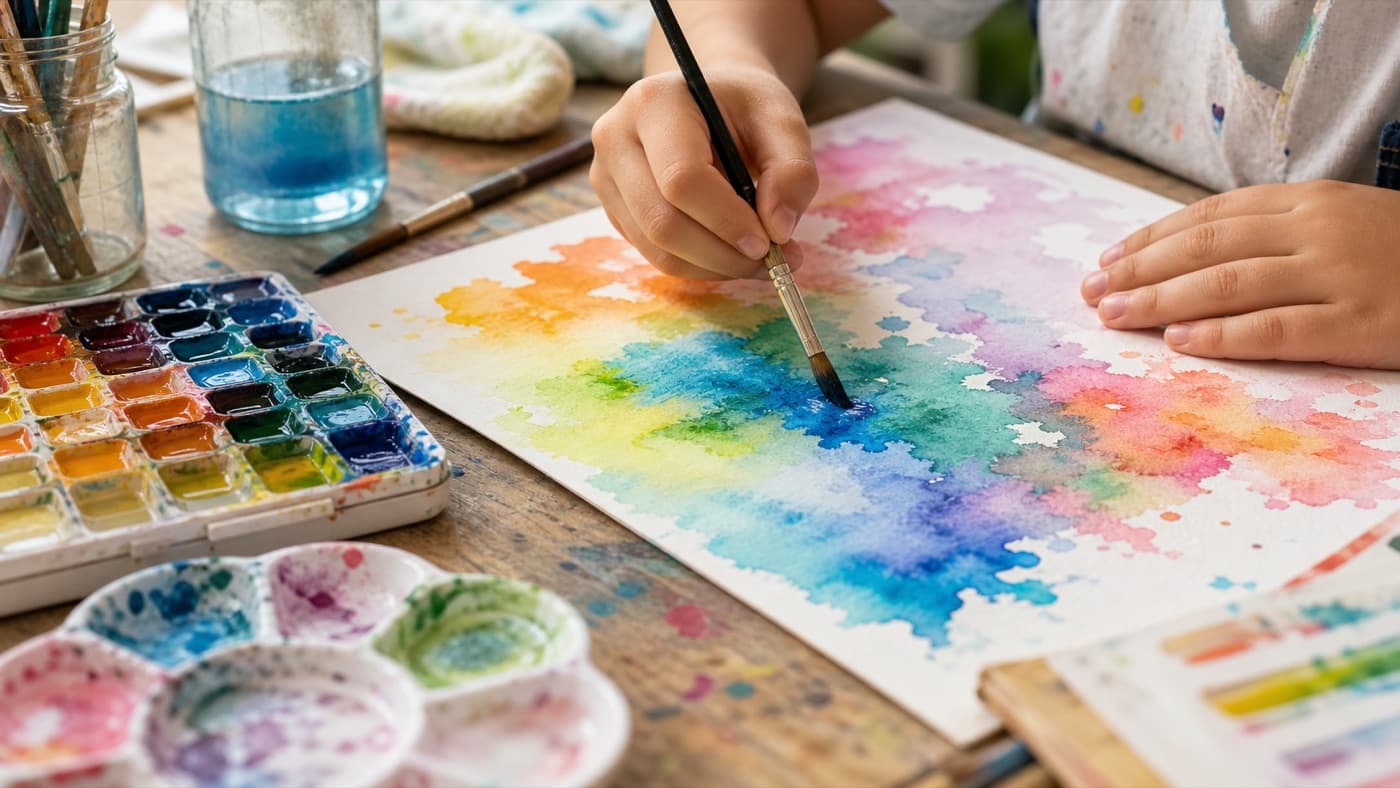
When children take their first watercolor class, what excites them most is often not what they painted, but the discovery that color can run by itself.
Blue drops into a wet sheet of paper and slowly spreads. Yellow touches red, and the edge turns orange. More water makes color feel like mist. Less water makes it look like a candy shell.
At that moment, watercolor is not only painting. It becomes a small experiment.
Science is hidden inside watercolor
The most fascinating part of watercolor is that it cannot be fully controlled.
The same stroke behaves one way on dry paper and another way on wet paper. More water, less water, faster brush, slower brush: each choice changes the picture.
Children naturally begin to ask questions as they try:
Why does the color spread?
Why do two colors make a new color when they meet?
Why does some paper wrinkle while other paper does not?
Why does the edge look different if I wait before painting again?
Behind these questions are absorption, diffusion, concentration, material differences, and the effect of time. Children do not need to learn all the technical terms immediately, but they are already touching scientific thinking through art: observing, guessing, testing, comparing, and adjusting.
Color learning is not memorizing a color chart
Many children know red, yellow, and blue, but they truly enter the world of color through feeling.
The same blue can be morning blue, ocean blue, rainy-day blue, or the blue outside a window at night. Green can feel fresh or quiet. Red can feel lively or tense.
In ET Art Studio's watercolor classes, we encourage children to describe colors, not only name them.
This purple feels like grape flavor.
This gray-blue feels like it is about to rain.
This yellow feels like the moment a lamp turns on.
When children can use color to express feeling, color is no longer just a tool for filling space. It becomes a language for storytelling.
Watercolor teaches children to accept what cannot be fully controlled
Some children feel nervous at first: Teacher, it flowed outside the line.
Watercolor does flow. It blooms, mixes, leaves water marks, and sometimes creates unexpected edges.
But that is exactly watercolor's gift.
Children learn that some effects do not come from using more force. They come from waiting, observing, and following what is happening. A water mark does not always need to be erased. It might become a cloud, a mountain, a shadow, or a transparent little jellyfish.
This experience suits children well, because growing up is not fully controllable either. Art class gives them a safe place to practice facing change.
Small watercolor experiments you can try at home
Parents can try a few simple exercises with children at home:
- Paint one stroke on dry paper and one on wet paper, then compare the edges.
- Drop red and yellow separately onto wet paper and watch how they meet.
- Sprinkle salt onto half-dry watercolor and observe the texture.
- Gently lift color with a tissue and see whether you can make clouds.
- Use only one color to paint five small squares from light to dark.
These exercises do not require realistic drawing, but they help children understand materials.
What kind of child is watercolor suitable for?
Watercolor is well suited to children who like colors, stories, and nature themes. It also suits children who need a relaxed way to express themselves and build patience.
Younger children can begin with color games, nature observation, and fairy-tale themes. Older children can learn more complete composition, layers, light and shadow, and personal style.
At ET Art Studio, we want children to feel watercolor's freedom while gradually learning methods. Freedom and technique do not conflict. A good class helps them support each other.
A single drop of color can become a lesson
Watercolor helps children see that the world is not made only of clear boundaries. It also has flow, transparency, layering, and waiting.
That is part of what makes art fascinating, and it is also a precious part of learning for children.
If you would like your child to experience a watercolor class that combines color, materials, and creativity, follow ET Art Studio. We use age-appropriate ways to turn water and pigment into one discovery after another.